Volume 30
Boston tech week basketball tournament; How do you build your own AI agent?; A-Star raises a $450M fund for seed startups; 20+ roles at Cognition, Harvey, Figure, and more


📣 Announcements
Our official membership is launching soon….submit an application to be considered for first access.
Calling all freelancers and creators-
If you want to list services / be considered for brand deals, submit an application here! We’ll connect you with founders + execs in our community.
Lastly…we have space for ONE MORE team for our basketball tournament in Boston! Sign up link below.
Vol 30 TLDR:
AI agents are emerging as the next major consumer product category — Poke, Lindy, Vellum, OpenClaw, and Hermes Agent lead the wave of always-on personal assistants, and we go under the hood on the five architectural layers behind every one of them (model, instruction file, tools, memory, hosting) — plus where they actually break in production
A-Star Fund III closes $450M for seed-stage; Infineon’s Humanoid Robotics Challenge closes applications May 27; Meridian Ventures launches $35M for MBA-deferred founders; PTC for Startups opens free CAD/PLM tooling to all industries
20+ jobs at CellType, Retell AI, Physical Intelligence, Cognition, Figure, Harvey, Cluely, EliseAI, ElevenLabs, Polymarket, and more
📅 Coming Up...
[Boston] Tech Week Basketball Tournament, 5/27 (Wednesday)
For founders, investors, startup teams, and solo players. Spectators welcome (registration still required).
full boston tech week calendar - here
[NYC] Tech Week Founder Wellness, 6/3 (Wednesday)
Founders only. Sunset rooftop mixer, sauna, cold plunge, red light therapy, and refreshments.
[NYC] Game Night, 6/9 (Tuesday)
Founders + startup engineers. Poker and assorted games.
⚖️ Opportunities & Resources
A-Star Fund III ($450M seed): Kevin Hartz and Bennett Siegel’s A-Star closed a $450M Fund III on May 12, deploying $3–5M average checks into 30–40 seed-stage companies. Concentrated, founder-led firm — worth a line in the room for anyone raising this year.
Infineon Startup Challenge 2026 (Humanoid Robotics): applications close May 27 for the latest cohort, focused on artificial sensing, sensor fusion, virtual interaction, and precision motor control for humanoid and autonomous robots. Announced May 12.
PTC for Startups: PTC expanded its startup program on May 13 to all industries (previously hardtech-only), offering qualifying early- and growth-stage startups free 5-user seats of Onshape CAD, Creo+, and Codebeamer+ ALM tools.
Meridian Ventures ($35M, MBA-deferred founders): announced May 15, a new $35M fund specifically backing founders who deferred or dropped out of MBA programs to build. Niche thesis, but a clear fit for a real chunk of the community.
Shopify just re-opened their Design Apprenticeship program:
 Katarina Batina@katarinabatinaWe're growing our Design Apprenticeship Program @Shopify, opening applications for our Fall cohort today! We've expanded the program to include brand design in addition to product design 😎 Come join us shopify.design/dap2:48 PM · May 18, 2026 · 34K Views16 Replies · 28 Reposts · 261 Likes

✍🏻 Culture Report: Your Most Texted Contact
Written by Annie Dong.
In a few months, your top pinned contact in iMessage might not be your mom or your significant other. It may very well be a personalized AI agent, on standby to handle your least favorite manual tasks.
While most consumers still engage with AI through general LLM providers like ChatGPT and Claude, a noticeable shift toward agents is underway. Whereas a chatbot is a single-turn system — it takes an input, produces an output, and waits — an agent operates in a loop: it receives a goal, divides it into steps, calls tools, evaluates the results, and decides what to do next, autonomously repeating the loop until the task is complete.
After years of flashy demos, a new class of consumer agents — from text-based personal assistants to open-source self-hosted alternatives — is now actually simplifying consumers’ lives. The question for most people isn’t whether to use one. It’s whether to build their own or take what’s already on the shelf.

Do You Actually Need an AI Agent?
AI agents are a specific tool for a specific type of problem: messy, multi-step, judgement-heavy manual work that happens often. They are not, by default, a superior solution to general workflow automation.
The distinction comes down to whether the path is known before you start. For tasks where the path is predictable — say, copying form data from one app to another on a fixed trigger — rule-based automation is faster, cheaper, and more reliable. For tasks where the path has to be figured out while working, agentic workflows are a better fit.
A useful rule of thumb is that if a single unexpected input would break your automation, you probably need an agent.
For consumers, examples of tasks that are a good fit for agentic workflows include: building a weekly digest of companies you’re tracking; managing your calendar and resolving scheduling conflicts; identifying and summarizing the most interesting items from your news and newsletter subscriptions; drafting responses to recurring email types; running ongoing research projects in the background between sessions.
Build or Buy?
An off-the-shelf agent can be configured and deployed in minutes. For the most common use cases — scheduling, email triage, reminders, basic research — there’s now a long list of products that work well and cost less than what you’d spend figuring out the alternative. They’re also maintained by vendors, alleviating users of the engineering burden as models update, APIs change, and tools break.
The case for building a bespoke personal agent is control, particularly data control. Agents are given significant access to personal context, and with an off-the-shelf product, that data is processed on a vendor’s servers. Building keeps your data local.
Building also lets you tailor solutions to hyper-specific problems. One user recently built an agent that automates his entire job hunting process: scraping LinkedIn listings every day, rewriting his resume for each role, and emailing him five ready-to-apply applications before 7am. No off-the-shelf product does that, and no off-the-shelf product is going to.
The catch is that building an agent is harder than it appears, and users tend to hit two consistent problems. The first is hosting: the agent needs to live somewhere that stays on. If it runs on a laptop, it goes offline the moment the laptop closes. The second is specification: you need to clearly and precisely explain the job you want done in plain English. The downstream effects of a misguided core instruction file can be profoundly detrimental — an agent that misunderstands its mandate doesn’t fail quietly; it fails confidently and repeatedly.
What’s On the Shelf
The consumer agent market has gone from speculative to crowded in less than a year. Here’s where the energy is concentrated right now:
Poke ($15M Seed) — a general-purpose assistant accessible through iMessage, SMS, and Telegram. Handles daily planning, calendar management, health and fitness tracking, smart home control, and photo editing, all via text message.
Lindy ($25M Series B) — an AI executive assistant that labels every email and drafts replies in your voice, finds meeting times and sends invites, briefs you before calls, takes notes during them, and sends recaps and action items after.
Vellum ($20M Series A) — a personal assistant built around persistent memory. Stays active in the background, reaches out on Telegram or Slack when something needs attention, and handles email, scheduling, research, and other tasks without needing to be prompted.
OpenClaw (open-source) — free and open-source autonomous AI agent built by Austrian developer Peter Steinberger. Runs locally on your machine and reaches you through WhatsApp, Telegram, Signal, iMessage, and 20+ other platforms.
Hermes Agent (open-source) — a self-hosted, Python-native agent framework that runs on your own machine and connects to the messaging platforms and tools you already use. Where OpenClaw is built around a JavaScript skill system, Hermes gives Python developers full programmatic control over every aspect of agent behavior.
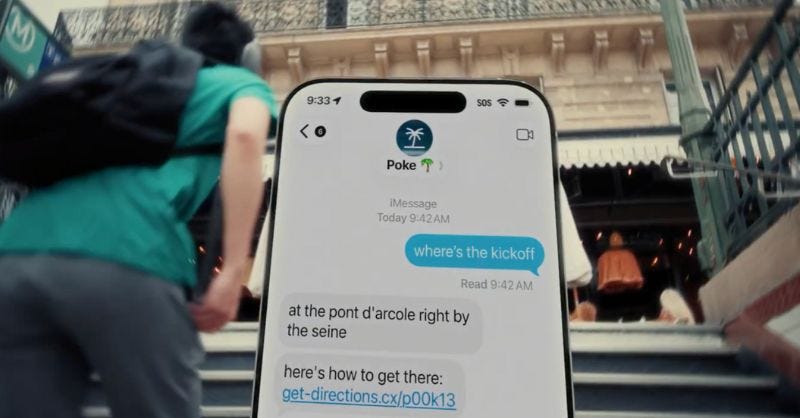
Where you land mostly comes down to where you sit on the convenience-versus-control spectrum. Most users will find Poke or Lindy enough. Power users with privacy concerns and a willingness to debug will gravitate toward OpenClaw or Hermes. Either way, the era of the agent as a serious daily-driver tool — not just a demo — has arrived.
⚙️ Under the Hood: How Do You Actually Build a Personal AI Agent?
Written by Priyal Taneja.
About a year ago, building a personal AI agent meant stitching together a dozen APIs by hand, writing custom authentication logic for each one, and maintaining all of it yourself. Today, the Model Context Protocol (MCP) has surpassed 97 million downloads, there are over 13,000 pre-built tool servers available publicly, and frameworks exist that can scaffold a working agent in two terminal commands. The barrier to entry has collapsed.
What hasn’t gotten easier is the part that matters most: designing an agent that actually does what you want, reliably, without supervision.
For anyone considering building their own agent rather than buying one off the shelf, here’s what the architecture actually looks like — a technical map of the decisions involved, the layers you need to assemble, and the places where things tend to go wrong.

The Five Layers of an Agent
Building a personal agent comes down to five architectural decisions, and each one represents a layer in the stack. Get any of them wrong and the agent either doesn’t work, doesn’t last, or starts doing things you never intended.
The model. The reasoning engine at the center of everything. Hosted models (Claude, GPT, Gemini) are more capable and easier to set up, but your data passes through their servers. Open-source alternatives like Llama can run entirely on your machine, keeping everything local, but they demand more hardware and tend to struggle with complex multi-step tasks. For most personal agents, a hosted model with a well-documented API is the practical starting point.
The instruction file. Arguably the most underestimated layer. This is a persistent, system-level document that defines who your agent is: its role, its boundaries, what it should prioritize, and how to handle ambiguity. Instead of “find me relevant jobs,” a well-crafted instruction file specifies role type, geography, company stage, industries to exclude, and the format to deliver results in. Every ambiguity you leave unresolved becomes a decision the model makes on its own, and it won’t always decide the way you would.
The tools. Without tools, an agent is just a chatbot with a good memory. Tools are the external capabilities it can invoke: reading email, searching the web, querying a database, sending a message. MCPs have become the standard here, providing a universal adapter layer with pre-built servers for Gmail, Google Calendar, Slack, GitHub, Stripe, and thousands of other services. The tools you give an agent define the boundaries of what it can do in the world.
Memory and state. A useful agent needs to remember things between sessions. What did it send you yesterday? What feedback did you give? Without persistent memory, it starts from zero every run and can never learn from its mistakes. Most frameworks handle this through structured conversation logs paired with a lightweight database or vector store. The design question is what to remember and what to forget — storing everything bloats the context window while storing too little means the agent keeps repeating the same errors.
Hosting and scheduling. For an agent to run autonomously, it needs infrastructure that stays on regardless of whether your laptop is open. On the simple end, a $5/month VPS on Railway or Fly.io runs a lightweight process continuously. Serverless functions triggered by cron schedules let you pay only for the compute the agent actually uses. Hermes Agent, for instance, is designed to be self-hosted on your own machine and connects to WhatsApp, Telegram, Signal, and iMessage natively. The right choice depends on how critical it is that your agent never miss a scheduled run.
Where Things Actually Break
The architecture sounds clean when you lay it out. The real challenge is what happens after setup, when the agent runs unsupervised and encounters situations you didn’t anticipate.

Specification drift. The agent’s behavior slowly diverges from what you intended because the instruction file didn’t account for edge cases that only surface after repeated use. The model fills in the gaps with its own judgment, and those small interpretive decisions compound across hundreds of runs. The best builders treat their instruction file as a living document, refining it weekly based on what the agent actually did versus what they wanted.
Tool failures. External services go down, APIs change schemas, rate limits get hit. The agent needs to know whether to retry, skip, or notify you rather than proceeding with incomplete information. Most frameworks include basic retry logic, but handling failure gracefully across multiple tool dependencies requires real thought about fallback behavior. An agent that confidently emails you “no new opportunities found today” because the LinkedIn API was down is worse than one that doesn’t run at all.
Context bloat. As the agent accumulates history across sessions, its context window fills up. Performance degrades, costs increase, and the model starts losing track of its own instructions. Managing this means actively summarizing older interactions, pruning irrelevant history, and keeping the working context focused on the immediate task.
Permission creep. As you give the agent more tools, the blast radius of a mistake grows. An agent with email write access can send embarrassing replies. An agent with calendar write access can delete your meetings. The principle most experienced builders follow is least privilege: start with read-only access, add write access only where you’ve verified the agent’s reliability, and require human confirmation for any irreversible action.
What’s Actually Changed
A year ago, each of these layers required significant engineering effort. Today, the infrastructure is largely solved. MCP handles tool integration. Frameworks like mcp-agent handle the reasoning loop, memory, and deployment. Cloud platforms have made always-on hosting trivially cheap.
What remains genuinely hard is the design work: defining precisely what you want the agent to do, anticipating the edge cases, and iterating on its behavior over time. The engineering has gotten easier. The core thinking hasn’t.
🔍 Companies and People to Watch
Parallel Web Systems (Series A, $100M): Web search API for AI, founded by ex-Twitter CEO Parag Agrawal. a16z-backed; building out senior commercial team post-raise (Head of Marketing, Comms, and GTM all open).
Multifactor (YC F25): Zero-trust authentication, authorization, and auditing infrastructure for AI agents. Sits in exactly the spot every enterprise deploying agents needs — auth for non-human identities.
Sycamore: AI infrastructure startup with very recent funding and an active careers page. Founding-stage engineering and research hires open.
Floot (YC S25): AI-first software foundation for non-coders to build and deploy full-stack web apps. 600+ paying customers during YC at just two people. Founders ex-AWS infrastructure and Retool staff.
EffiGov (YC S25): AI OS for local governments — AI call takers that answer city phone lines 24/7 for permits, animal control, utility inquiries, and more. SOC 2 Type II certified at a 3-person team. Founders ex-White House and ex-Atlassian (Rovo AI agents).
Glimpse: Consumer AI product with strong early traction. Dual hiring on engineering and founding ops — rare to see both at once.
Cloaked: Privacy tech with an active Ashby board and multiple confirmed roles. POC: Arjun Bhatnagar (co-founder). Direct founder access on outreach.
Tenex.AI: AI operations platform with 65+ live roles on Ashby — the highest role density of any company we tracked this month. Worth a deeper pass for anyone in ops, sales, or engineering.
🦄 Jobs
CellType: foundation models for single-cell biology. Founding Research Engineer, Model Training (SF)
Retell AI: voice AI infrastructure for customer-facing teams. Founding Senior AI Automation & CS Engineer, Founding Senior ML Engineer, Senior Software Engineer (Support Automations) (SF)
Cluely: real-time AI overlay assistant. Founding Mobile Engineer (NYC)
EliseAI: vertical AI agents for housing and healthcare. Founding Senior SWE, Full Stack (Healthcare) (NYC)
Physical Intelligence: general-purpose AI brain for robotics (Series A, $400M). Head of Process Engineering (SF)
Cognition: maker of Devin, the autonomous AI software engineer. AI Enablement Engineer, AI Enablement Operations, Deployed Engineer (Tokyo), Partner Deployed Engineer (Europe) (SF, Tokyo, Europe)
Harvey: AI for the legal industry (~$5B Series E). Legal Engineer, Applied Legal Researcher, Legal Engineer (EMEA) (NYC, SF, London)
Figure: general-purpose humanoid robots. Helix AI Engineer (Sunnyvale)
Windsurf: AI-native IDE and coding agents. Deployed Engineer, Pre-Sales (Mountain View)
ElevenLabs: AI audio & voice generation. Full-Stack Engineer (Remote, Europe)
Eight Sleep: sleep fitness hardware & software. Senior Software Engineer, Backend (NYC / Remote)
Polymarket: largest prediction market in the world. Software Engineer, US Exchange Tooling; Software Engineer, Internal Tools (NYC)
👀 Interesting Things from This Week
The AI-compute public-market window reopens. Cerebras priced its IPO this week — the first major AI-compute listing in over a year and a clear signal that public-market appetite for picks-and-shovels AI infrastructure is back. Watch this as a leading indicator for Groq, SambaNova, and other inference-cloud names lining up behind it.
SpaceX IPO talk surfaces at ~$2T. Musk publicly suggested a SpaceX IPO is “imminent” with a targeted ~$2T valuation — would be the largest tech listing in history if it lands at that range.
Cool article on how to create opportunities for yourself:


📷 Photos of the Week

ft. last week’s game night (NYC)
See you next week,
Maggie + Jonas
