Volume 29
We're launching something big.....


📣 Announcements
Something big is coming…we’re SO excited about it that this week’s newsletter is free for everyone.
Up until this point, we’ve never had an official membership, or even a group chat.
That changes soon. If you’re a founder, builder, or job seeker - we built something for you. A private network, intel, opportunities, and resources designed to give you an unfair advantage.
We’re giving you first access. Apply here to be considered for our founding cohort.
Now, back to our regular programming.
Vol 29 TLDR
AI is reshaping the ~$45B B2B sports tech market — from injury prediction to real-time tactics. 38 cameras and 3D pose estimation form the tracking layer behind the NFL’s Digital Athlete, FIFA’s 2026 World Cup scans, and the NBA’s Dragon platform
Replit Vibecon hits NYC June 17–18. Stealth companies to watch include Mercator, Virgil, and ex-DeepMind’s Pannag Sanketi
45+ jobs at Robinhood, Threads, Parallel, Rogo, Abridge, and more
📅 Coming Up...
[NYC] Game Night, 5/14 (Thursday)
For founders + startup engineers. Poker and other games.
[Boston] Tech Week Basketball Tournament, 5/27 (Wednesday)
For founders, investors, startup teams, and solo players. Spectators welcome (registration still required).
[NYC] Tech Week Founder Wellness, 6/3 (Wednesday)
Founders only. Sunset rooftop mixer, sauna, cold plunge, red light therapy, and refreshments.
⚖️ Opportunities & Resources
Replit Vibecon (AI + Creative Conference): the first AI creative conference connecting code to culture is coming to NYC, June 17–18. Limited early bird tickets available.

✍🏻 Culture Report: Has AI Replaced the Coach?
Written by Annie Dong.
Before a big game, Philadelphia Eagles offensive tackle Lane Johnson watches film for three hours a day, five days a week. Every player on the team has their own tablet loaded with assigned videos on a daily basis.
Watching and studying film enables athletes to anticipate the opposing teams’ strategy, producing a “super-clear picture of what situation we’ll be in, what coverage, where I’ll be at on each and every snap” (former safety Malcolm Jenkins).
Prediction and preparation have always been essential to athletic excellence. Now, AI is further collapsing the gap between preparation and real-time action both on and off the field, propelling the growth of the ~$45B B2B sports tech market.
Off the Field
Prediction begins in the training room. While sports medicine has been historically reactive by definition, ML models can now ingest data such as player workload statistics, biomechanics, training footage, sleep and wellness logs, etc. to proactively flag when an athlete is at risk of injury.
The NFL’s Digital Athlete, built in partnership with AWS, is the most ambitious deployment of this yet. The system uses 38 high-speed 5K cameras to track 29 points on every player’s body 60 times per second, combining that tracking data with practice loads, injury records, and field conditions to run millions of simulations of in-game scenarios. All 32 clubs receive a daily update of personalized training volume and injury risk information for every player on their roster. In 2024, the NFL reported its lowest concussion rate on record, a 17% decrease from the prior year.
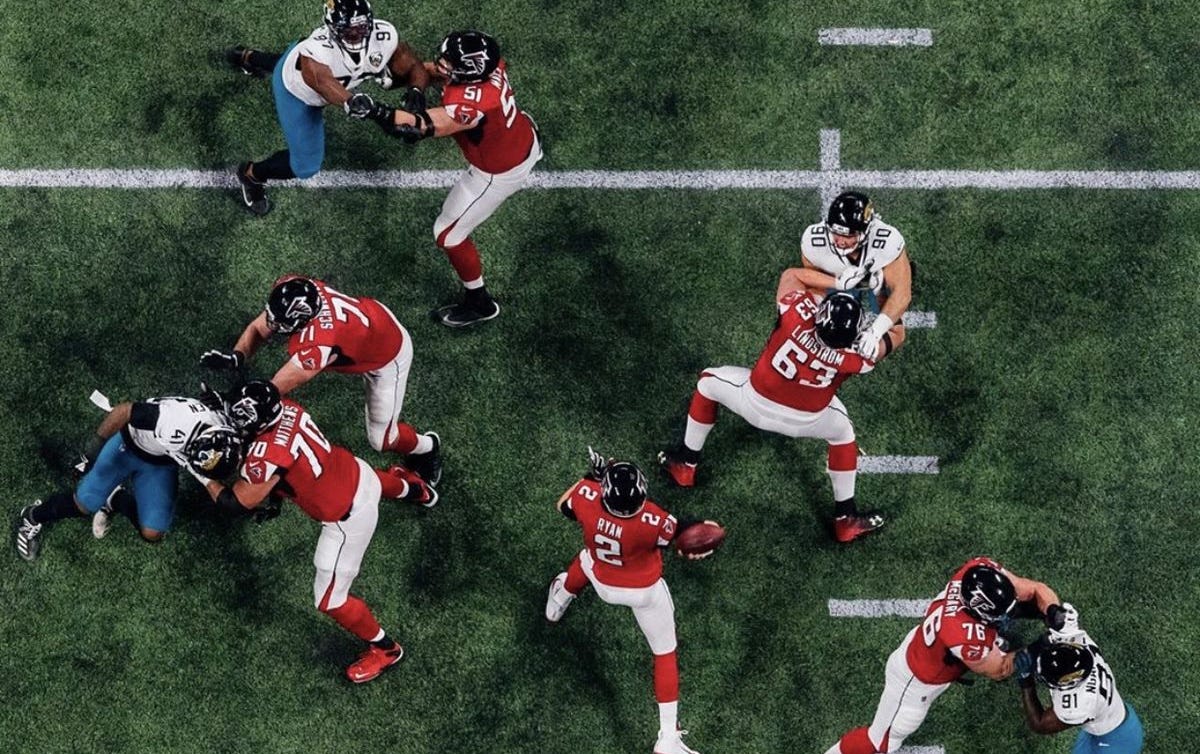
Beyond American football, Zone7 works with over 50 global soccer and rugby clubs, analyzing over 200 million hours of football data to predict injury risk with 72% accuracy. Its deployment has been credited to a 40% reduction in injury volume for its early customers.
Amongst a growing number of Achilles ruptures among star players during the 2023–2024 season, the NBA also announced last year that the league is actively developing a centralized AI system to monitor and mitigate injury risks.
Injury has always been the one variable no team could control. AI is making it one they can.
While the Clock is Running
AI is also being rapidly deployed on the field (and the track) to optimize in-game strategy.
Since the 2025 season, the NFL’s 2500+ Sideline Viewing System has been supercharged with AI agents. These agents auto-filter past plays, flagging relevant clips based on the live down, distance and formation, presenting the adjustment solution before the next play begins.
The NBA has followed suit, with its “Dragon” platform from Second Spectrum capturing the entire surface area of a player’s body to monitor defensive spacing and shot probability. Further, the AI detects minute decreases in a player’s “cut speed” and accordingly recommends substitutions.
In La Liga, Sportian’s AI agents monitor team formations and passing patterns in real time, alerting the bench and suggesting counter-tactics immediately if the opponent’s formation shifts.
More recently, nine-time constructors’ champion Atlassian Williams F1 team announced its partnership with Claude to optimize decision-making for race strategy and on-track situations. Technology spending for F1 teams reached an estimated $769M last season.
The biggest test of all this is coming this summer. FIFA and Lenovo have announced that every player at the 2026 World Cup will be digitally scanned to create a precise 3D model — each scan taking approximately one second — which the system uses to track players reliably through fast or obstructed movements. Built on FIFA’s Football Language model, Football AI Pro will analyze hundreds of millions of data points per game, generating insights for coaches and analysts.
On today’s fields, every coach has an AI analyst sitting next to them.
Other Interesting Use Cases
The training room and the sideline are the most visible deployments. Here’s what’s happening everywhere else.
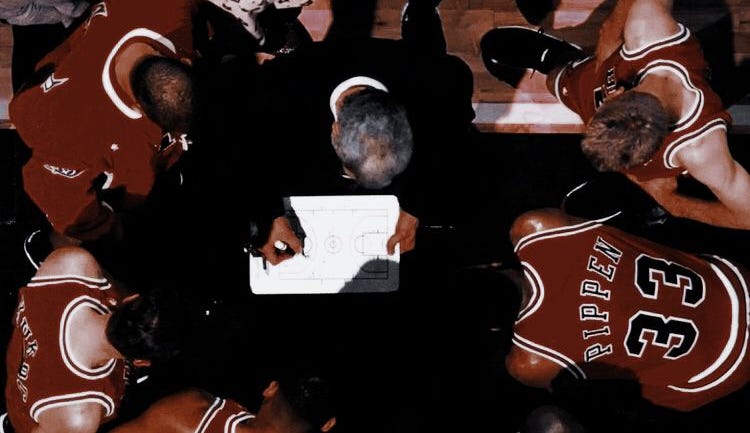
AI Scouting: Using computer vision and predictive analytics to evaluate prospects from uploaded drill footage at scale; measuring speed, agility, and technique against professional benchmarks. AiScout has partnered with clubs across top European leagues to widen their scouting net beyond traditional academies.
AI Officiating: Using computer vision and sensor fusion to automate refereeing decisions in real time. The ATP Tour eliminated human line judges entirely in 2025. MLB’s automated ball-strike system, tested in spring training, overturned 52% of challenged calls.
Autonomous Highlight Generation: Using computer vision and audio signal detection — crowd noise, commentator excitement — to identify key moments and automatically produce customized highlight reels within seconds of the action. WSC Sports‘ platform is used by the NBA, Bundesliga, LaLiga, and the PGA Tour, generating thousands of clips per game without a human editor.
AI Coaching: Using computer vision and pose estimation to analyze athlete technique frame-by-frame via smartphone camera, delivering real-time feedback on angles, timing, and posture without wearables. BeOne Sports is partnering with Rice University’s sports medicine program to deploy this for injury prevention and performance optimization. HomeCourt (NBA-backed) uses smartphone cameras to give basketball players shot analysis, dribbling feedback, and drill metrics in real time. Mustard applies the same logic to baseball, using AI to analyze pitching mechanics via phone video and deliver personalized coaching feedback.
⚙️ Under the Hood: How Does a Camera Track 22 Players at Once?
Written by Priyal Taneja.
During every NFL game this season, 38 high-speed cameras positioned in a ring around the stadium are recording 5K video at 60 frames per second. That’s roughly 6.8 million video frames processed per game week, capturing the movements of every player on the field from 38 different angles simultaneously. The footage gets uploaded to the cloud, where a computer vision algorithm locates the core and extremities of each player and constructs a 3D virtual skeleton in real time. By the end of a single game, the system has generated approximately 15,000 miles of player tracking data.
Every AI application in modern sports — from injury prediction and real-time tactical adjustments to automated officiating and highlight generation — depends on this same foundational capability of knowing exactly where every player is, how they’re moving, and what their body is doing, at every moment of the game. The tracking layer is the infrastructure that makes everything else possible, and building it is a far harder computer vision problem than most fans realize.
From Dots to Skeletons
Player tracking in professional sports has evolved through two distinct generations.
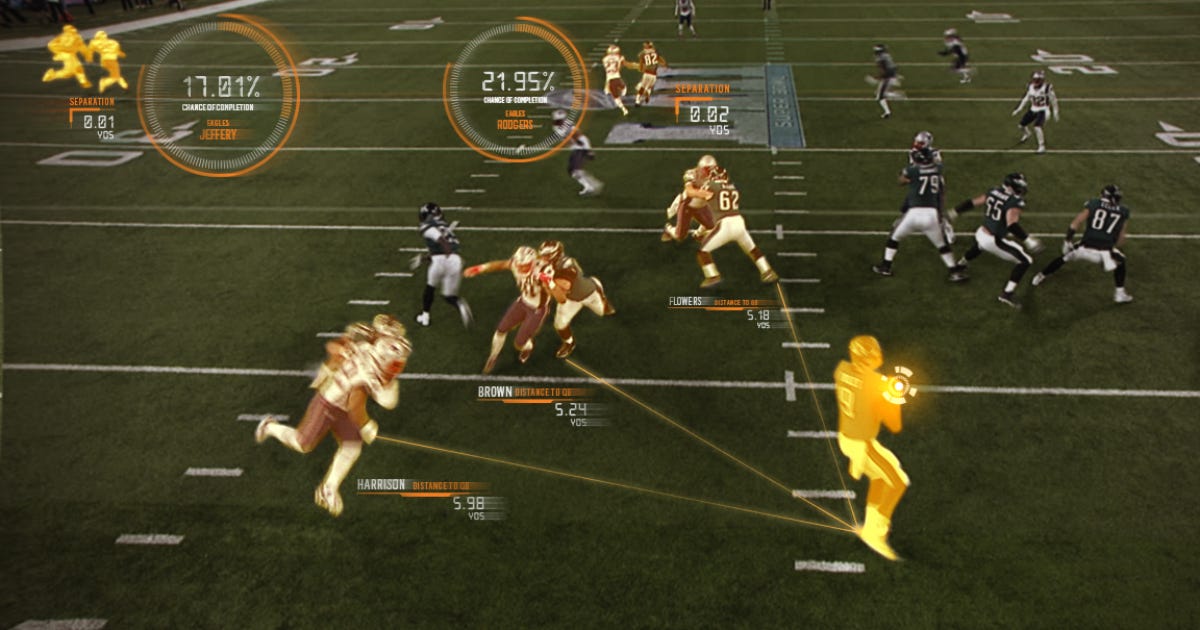
The first wave of player tracking relied heavily on RFID sensors. Since 2015, the NFL has embedded radio-frequency chips in every player’s shoulder pads, capturing X/Y coordinates, speed, distance traveled, and acceleration 20 to 25 times per second. This data powered the “Next Gen Stats” graphics that fans see during broadcasts, showing players as colored dots moving across a 2D field map. RFID tracking is both reliable and precise for position, but it treats every player as a single point. It knows where a player is, but nothing about what their body is doing.
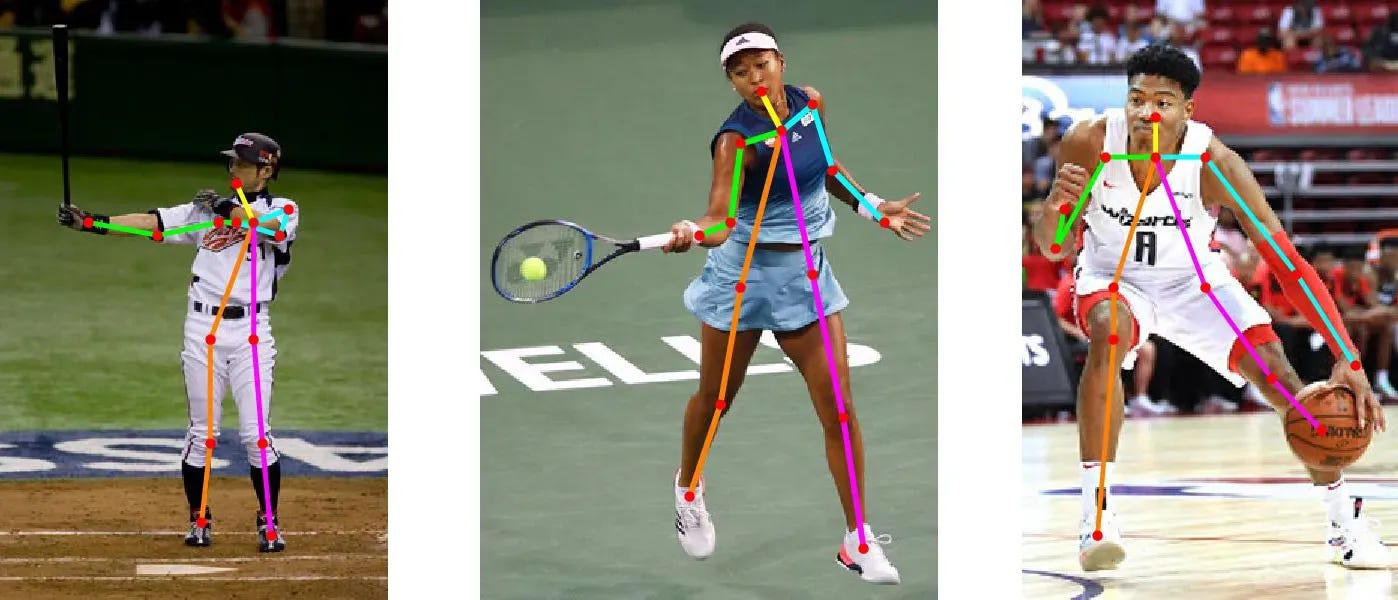
The second generation is optical tracking with pose estimation, and it’s what the NFL’s Digital Athlete program, FIFA’s 2026 World Cup system, and the NBA’s Second Spectrum platform are all built on. Instead of tracking a dot, the system tracks a full 3D skeleton by identifying 29 or more distinct body points (joints like elbows, knees, hips, ankles, and wrists) across every frame of video. This is where the real technical complexity lives.
The Pose Estimation Pipeline
Turning raw camera footage into a 3D skeleton for every player on the field involves several layers of computation, each solving a different piece of the problem:
Detection and identification. The system first has to find every player in every frame and figure out who each one is. In a sport like football, where 22 players are wearing similar uniforms and helmets, this is nontrivial. The models use a combination of jersey number recognition, body shape priors, and temporal tracking (following the same player across consecutive frames) to maintain consistent identity assignments even through collisions, pile-ups, and camera angle changes.
2D pose estimation. For each detected player, a convolutional neural network (CNN) identifies the pixel coordinates of each body joint within that camera’s frame. Models like OpenPose and HRNet are designed specifically for this task, producing a 2D skeleton overlay for each player in each camera view.
Multi-view fusion and 3D reconstruction. A single camera only gives you a 2D projection. To get true 3D coordinates (which is what you need to measure things like joint angles, torso lean, or the precise height of a player’s knee during a tackle), the system triangulates across multiple camera views. The 38 cameras in an NFL stadium are carefully calibrated and synchronized so that the same body point captured from different angles can be matched and triangulated into a single 3D position in space.
Temporal smoothing. Raw frame-by-frame pose estimates are noisy. A player’s estimated knee position might jump by a few centimeters between frames due to motion blur, partial occlusion, or detection errors. Temporal models smooth these estimates over time, enforcing physical constraints (a human knee can’t teleport or bend backwards) to produce clean, biomechanically plausible motion trajectories.
Why Sports Is Harder Than You’d Think
Pose estimation on a single, well-lit person standing against a clean background is a largely solved problem. Sports breaks nearly every assumption that makes that easy.
Occlusion is constant. Players overlap, pile on top of each other, and huddle in tight formations where individual bodies are barely distinguishable. The system has to maintain identity and skeletal tracking through frames where half a player’s body is hidden behind another player.
Speed is extreme. A wide receiver can change direction in under 200 milliseconds. At 60 frames per second, the system gets roughly 12 frames to capture that cut. Any latency in detection or tracking means the skeleton lags behind the actual body position, producing inaccurate joint angle data at exactly the moments that matter most.
Uniformity makes identification hard. Unlike pedestrian tracking in an urban setting (where every person looks different), sports tracking involves dozens of athletes in near-identical kits, similar body types, and overlapping movements. The system can’t rely on appearance alone and has to lean heavily on motion continuity and spatial reasoning.
And the playing surface matters. FIFA’s 2026 World Cup system will operate across 16 different stadiums in three countries, each with different lighting conditions, camera positions, and field dimensions. The model has to generalize across all of them without per-venue retraining.
What the Tracking Data Unlocks
Once you have a reliable 3D skeleton for every player at every frame, the downstream applications become possible. The NFL’s Digital Athlete can detect gait asymmetry (a sign of fatigue or emerging injury) by comparing a player’s left-right stride patterns across practices and games. Second Spectrum’s Dragon platform can compute defensive spacing down to the centimeter and predict shot probability in real time. FIFA’s semi-automated offside system can determine whether a player’s shoulder or knee was ahead of the last defender with millimeter-level precision, because it’s not guessing from a 2D broadcast angle anymore. It’s measured from a calibrated 3D model.
This is also why FIFA is scanning every player at the 2026 World Cup to create individualized 3D avatars. The generic skeleton models used at the 2022 World Cup drew criticism because the avatar proportions didn’t match the actual players, raising doubts about the accuracy of tight offside calls. By scanning each player’s precise body dimensions beforehand and feeding those into the tracking system, the model knows exactly where each player’s shoulder ends and their arm begins, which is the difference between a goal and an offside call.
The tracking layer is the part of sports AI that fans never see, but it’s the reason everything else works. Every injury prediction, every tactical recommendation, every automated offside call starts with the same question: where is every player, and what is their body doing right now? The systems answering that question are processing billions of data points per season to turn raw video into a structured, three-dimensional understanding of the game, and the accuracy of everything built on top of that depends entirely on how well they do it.
🔍 Companies and People to Watch
Mercator: Decision intelligence layer for global supply chains; replaces spreadsheet workflows with an orchestration platform.
Founder: Megha Malpani (ex-PM Google Gemini & ChromeOS, Stanford GSB MBA)
Industry: Supply Chain AI, Enterprise Software, 9 months in stealth
Virgil: Context engine for AI-native investment banks and private funds
Founder: Crawford Hawkins (ex-Tiger Management PM, ex-Elliott Management, Columbia MBA, prior co-founder of Bottleneck)
Industry: FinTech, AI Infra, 1.5 years in stealth
Amir Frenkel — Founder
Former VP of GenAI, XR Tech – Reality Labs at Meta; Engineering Director Head of AR & Wearables at Google; Chief AI Officer at Eclipse
2 months in stealth
Pannag Sanketi — Founder
Former Robotics Lead at Google DeepMind (Gemini Robotics, Table-Tennis Robots, Open X-Embodiment), Berkeley PhD
2 months in stealth
Jocelyn Shieh — CEO (Serial Founder)
Former CEO at Chaima (a16z speedrun), Accelerator Head at Google Play VC/Startups, BD at Unity, UC Berkeley
2 months in stealth
🦄 Jobs
Revin: AI for the trades. GTM, Fullstack, Ops, Marketing (NYC)
Acely: AI-powered test preparation platform ($10m ARR). Performance Marketing Lead (Remote)
Teero: platform helping dentists grow their practices. Operations Associate, Software Engineer, Community, Account Executive (Austin, Amsterdam)
Kepler: deterministic infrastructure for AI. Founding Full Stack Engineers (NYC)
Drogue: ocean-scale energy infrastructure. Founding Mechanical Engineer, Business Athlete (Washington DC)
HUD: infra for creating RL training data and selling to labs. Research Engineers + other roles (SF)
Freckle: GTM infrastructure for agents (7,000+ users, $6m raised). CTO (SF)
TypeSafe: frontier AI models for reliable, programmable intelligence. Senior Engineers (Platform & Data), Founding Recruiter, Designer + more (SF)
Dimensional: dimOS, agentic operating system for generalist robotics. Software, Infra, Manipulation, Navigation, LLM/Agents (SF, Shenzhen)
Reflow: workflow intelligence platform. Customer Success Manager, Forward Deployed Data Analyst (Remote)
Every: media + software + consulting hybrid. Head of Social, Head of Product Marketing, GTM Engineer (Remote)
Ploy: AI platform to optimize websites (founded by Webflow founder). Growth Solutions/Customer Success Specialist (NYC, SF)
Rexi: finance operations platform. Founding GTM (Remote)
Earleads: GTM engineering as a service ($1m ARR). Content Writer (Remote)
Plug: marketplace for electric vehicles ($100m in EV sales). Director of Marketplace Operations (LA)
Hey Noah: AI-assistant for executives. Founding Growth Lead (SF)
Ajax: AI platform for lawyers to automate timekeeping. Founding Customer Activation (NYC)
Minicor: desktop automation platform. Forward-Deployed Engineer (SF, Remote)
Stand: insurance platform for wildfires, hurricanes, etc. Founding Customer Success (SF)
Moxie: platform for aesthetics entrepreneurs (700+ customers). Revenue Operations & Strategy (Remote)
Industrious: largest premium workplace provider in the world (300+ locations). CEO (NYC)
Figure: public fintech with $8b valuation. C-Level Marketer (NYC, SF)
Robinhood: financial services. Senior Partnerships Manager, Crypto (NYC)
Wander: luxury vacation rental platform. VP of Customer Success (Austin)
Flex: banking platform for business owners. Videographer, Editor, Creative Director (SF)
Rogo: AI for the finance industry ($160m raised, unicorn). Customer Success Manager, Salespeople, GTM (London, SF, NYC)
Threads: Meta’s social media product (400m+ MAU). VP of Product (SF)
Assort Health: AI platform for healthcare call centers ($102m raised). Customer Success Managers (SF)
Parallel: web search API for AI ($100m raised at $2b valuation, founded by ex-Twitter CEO). Head of Marketing, GTM, Recruiter (SF, NYC)
Watershed: enterprise sustainability platform. Salespeople (SF, London)
Hadrian: autonomous factories for defense and aerospace. 160 roles across every department (LA, SF, Austin)
Pathlight: venture firm. Talent Lead (NYC)
Nyca Partners: fintech-focused VC. Investment Associate (NYC)
Ineffable Intelligence: AI lab on a mission to “make first contact with superintelligence” ($1.1B seed, founded by David Silver of Google DeepMind). Technical Staff (London)
Hercules: intuitive AI app builder (founded by ex-AWS product lead Brendan Falk). Product Engineer (SF)
Unlimited Industries: AI startup automating the construction process end-to-end ($12M seed). Obsessive Generalist + engineers across levels (SF)
Pomelo Care: healthcare for women & children. Senior Brand Designer (Remote)
Gamma: AI presentation/content platform. Forward Deployed Designer (SF)
Casa: membership to better manage your home ($27M raised, founded by ex-Uber product leader). Senior Backend Engineer (SF)
Raspberry AI: GenAI software for fashion creatives (founded by ex-DoorDash/Amazon). RevOps Lead (Remote)
Ulysses: ocean robotics. Head of Talent (up to $200K) (SF)
Heron Power: power infrastructure scaling from R&D to mass production. Head of Legal (up to $280K)
Abridge: AI for clinical documentation. Senior Brand Storyteller (SF)
Kalshi: prediction markets. Influencer Sourcing and Activation Lead (NYC)
AKASA: AI for clinical documentation and medical coding. Senior Product Manager (up to $240K + equity) (SF)
👀 Interesting Things from This Week
Higgsfield releases a virality predictor for content

See you next week,
Maggie + Jonas

👀