Volume 17 [community edition]
Nebius x The Collective partnership + their $275M acquisition of Tavily; Kalshi is hiring a stunt person; Polymarket’s free grocery store; Vibe-coding’s rise to fame


📣 Announcements
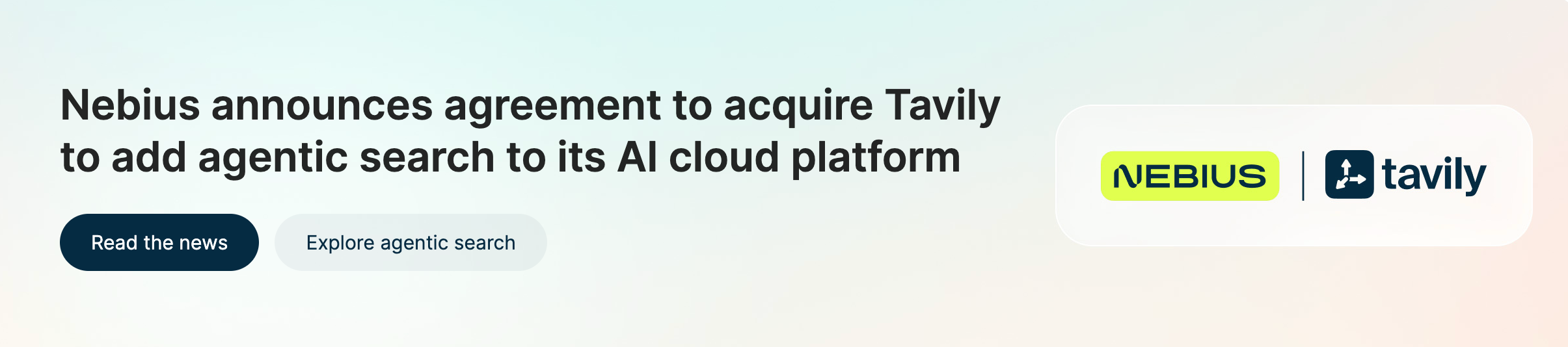
Nebius acquires Tavily for $275M! Huge congrats to both teams.
We’re excited to officially partner with Nebius. We’re cohosting an event in two weeks and The Collective members get free AI cloud credits worth $5k - $100k.
Join here.
Vol 17 TLDR:
Vibe-coding is redefining what it means to build a startup - how do coding agents actually work?
Polymarket opened NYC’s first free grocery store in the West Village
Fellowships at Soma Capital and Pear VC just dropped
Roles at Kalshi, Notion, Excetera, SideShift, Kindred Ventures, and more
📅 Coming Up…
Game Night (Thursday, 3/5)
Venture-backed founders + startup engineers
An Evening With Acrylic (Tuesday, 3/10)
Venture-backed founders
Upscale painting night + cocktails
⚖️ Resources
Soma Fellows Spring Batch - Up to $2M uncapped. April 1 deadline. Apply here
PearX S26 applications are now open - Apply here
Polymarket opened NYC’s first free grocery store - Read more

For the full list of resources (released weekly), subscribe here.
✍🏻 Culture Report: Vibe-Coding’s Rise to Fame
Written by Annie Dong.
The Birth of a Movement
The term “vibe-coding” was coined from a viral tweet by Andrej Karpathy, co-founder of OpenAI, in February 2025:
“There’s a new kind of coding where you fully give in to the vibes, embrace exponentials, and forget that the code even exists. I call it vibe coding.”
Since then, vibe-coding has taken the tech world by storm. Developer tools like Cursor ($29.3B valuation), Lovable ($6.6B valuation), Bolt.new (~$700M val) and Anthropic’s Claude Code ($350B val) have exponentially minimized the distance between ideation and production.
Today, the ability to code—once a coveted skill with high educational and technical barriers—has been massively democratized. Non-technical creatives are generating everything from platforms that turn Spotify playlists into postcards to web apps for listening to podcasts about podcasts.
How Vibe-Coding is Changing Startups
As early as February 2024, Sam Altman predicted: “We’re going to see 10-person companies with billion-dollar valuations…in my little group chat with my tech CEO friends, there’s this betting pool for the first year there is a one-person billion-dollar company, which would’ve been unimaginable without AI.”
Indeed, startups are operating leaner than ever. Anysphere (creator of Cursor) crossed $100M ARR in less than a year with fewer than 50 employees. Safe Superintelligence reached a $32B valuation with 20 employees. OpenEvidence hit unicorn status with 22 employees.
In Y Combinator’s Winter 2025 batch, 25% of startups had codebases that were 95% AI-generated. YC CEO Garry Tan summarized: “You don’t need teams of 50 or 100 engineers. You can raise less, and capital lasts much longer.”
What This Means for Founders
The commodification of code places newfound emphasis on two approaches:
For access to the full article, subscribe here.
⚙️ Under the Hood: How Coding Agents Actually Work
Written by Priyal Taneja.
Cursor, Claude Code, Codex, Copilot. They all promise the same thing: describe what you want, and the machine builds it. But what’s actually happening between your prompt and the working code?
Traditional Code Assistants: Autocomplete on Steroids
GitHub Copilot launched in 2021 as a fine-tuned GPT model that ingested your open file, pattern-matched against billions of lines of training data, and suggested completions. It operated on a single context window of 4,000-8,000 tokens—roughly one file. No knowledge of your broader codebase, no ability to run the code it wrote, no mechanism to verify its output.
What Coding Agents Change
At the core of every modern coding agent is a recursive feedback loop: reason, act, observe, correct.
When you tell Claude Code to “fix the failing tests,” it doesn’t just generate a patch. It runs the test suite. Reads the error logs. Traces the failure through the codebase. Generates a fix. Runs the tests again. If they still fail, it re-enters the loop. This cycle can chain dozens of actions before returning a result.
But even the best reasoning model is useless without the right context, and a production codebase can contain 500,000+ files. No model ingests all of that. So agents use Retrieval-Augmented Generation (RAG): the codebase is parsed into semantically meaningful chunks, each chunk is embedded into a vector database, and the system retrieves only the highest-relevance slices for a given task.
For access to the full article, subscribe here.
🦄 Jobs
Pocket - Founding AI Engineer
Excetera - Design Engineer (NYC)
Kalshi - Marketing & Stunt Person, Culture GTM
Thirdlayer (YC) - Founding Engineer, Brand Designer (SF)
Boost My School - Chief of Staff (finance-minded) (NYC)
For access to the full job list (updated weekly), subscribe here.
📷 Photos of the Week
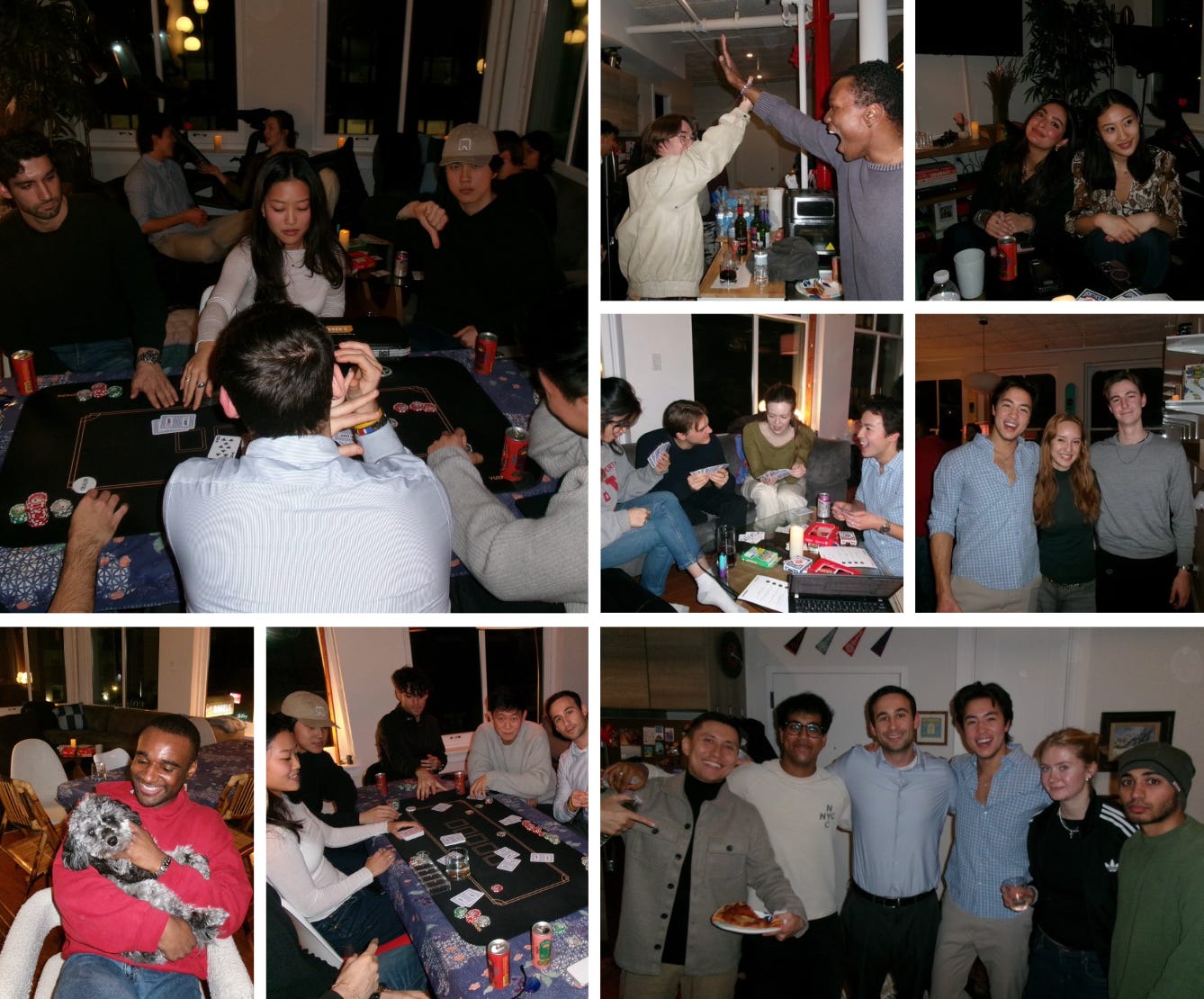
Last week’s poker + game night.
See you next week,
Maggie + Jonas
